Tag: Cyber Threats

  • Hackers Weaponize Windows Hyper-V to Hide Linux VM and Evade EDR Detection

    Hackers Weaponize Windows Hyper-V to Hide Linux VM and Evade EDR Detection

    Nov 06, 2025Ravie LakshmananMalware / Network Security

    The threat actor known as Curly COMrades has been observed exploiting virtualization technologies as a way to bypass security solutions and execute custom malware.

    According to a new report from Bitdefender, the adversary is said to have enabled the Hyper-V role on selected victim systems to deploy a minimalistic, Alpine Linux-based virtual machine.

    “This hidden environment, with its lightweight footprint (only 120MB disk space and 256MB memory), hosted their custom reverse shell, CurlyShell, and a reverse proxy, CurlCat,” security researcher Victor Vrabie, along with Adrian Schipor and Martin Zugec, said in a technical report.

    DFIR Retainer Services

    Curly COMrades was first documented by the Romanian cybersecurity vendor in August 2025 in connection with a series of attacks targeting Georgia and Moldova. The activity cluster is assessed to be active since late 2023, operating with interests that are aligned with Russia.

    These attacks were found to deploy tools like CurlCat for bidirectional data transfer, RuRat for persistent remote access, Mimikatz for credential harvesting, and a modular .NET implant dubbed MucorAgent, with early iterations dating back all the way to November 2023.

    In a follow-up analysis conducted in collaboration with Georgia CERT, additional tooling associated with the threat actor has been identified, alongside attempts to establish long-term access by weaponizing Hyper-V on compromised Windows 10 hosts to set up a hidden remote operating environment.

    “By isolating the malware and its execution environment within a VM, the attackers effectively bypassed many traditional host-based EDR detections,” the researchers said. “The threat actor demonstrated a clear determination to maintain a reverse proxy capability, repeatedly introducing new tooling into the environment.”

    Besides using Resocks, Rsockstun, Ligolo-ng, CCProxy, Stunnel, and SSH-based methods for proxy and tunneling, Curly COMrades has employed various other tools, including a PowerShell script designed for remote command execution and CurlyShell, a previously undocumented ELF binary deployed in the virtual machine that provides a persistent reverse shell.

    CIS Build Kits

    Written in C++, the malware is executed as a headless background daemon to connect to a command-and-control (C2) server and launch a reverse shell, allowing the threat actors to run encrypted commands. Communication is achieved via HTTP GET requests to poll the server for new commands and using HTTP POST requests to transmit the results of the command execution back to the server.

    “Two custom malware families – CurlyShell and CurlCat – were at the center of this activity, sharing a largely identical code base but diverging in how they handled received data: CurlyShell executed commands directly, while CurlCat funneled traffic through SSH,” Bitdefender said. “These tools were deployed and operated to ensure flexible control and adaptability.”


    Source: thehackernews.com…

  • SonicWall Confirms State-Sponsored Hackers Behind September Cloud Backup Breach

    SonicWall Confirms State-Sponsored Hackers Behind September Cloud Backup Breach

    Nov 06, 2025Ravie LakshmananIncident Response / Cloud Security

    SonicWall has formally implicated state-sponsored threat actors as behind the September security breach that led to the unauthorized exposure of firewall configuration backup files.

    “The malicious activity – carried out by a state-sponsored threat actor – was isolated to the unauthorized access of cloud backup files from a specific cloud environment using an API call,” the company said in a statement released this week. “The incident is unrelated to ongoing global Akira ransomware attacks on firewalls and other edge devices.”

    The disclosure comes nearly a month after the company said an unauthorized party accessed firewall configuration backup files for all customers who have used the cloud backup service. In September, it claimed that the threat actors accessed the backup files stored in the cloud for less than 5% of its customers.

    DFIR Retainer Services

    SonicWall, which engaged the services of Google-owned Mandiant to investigate the breach, said it did not affect its products or firmware, or any of its other systems. It also said it has adopted various remedial actions recommended by Mandiant to harden its network and cloud infrastructure, and that it will continue to improve its security posture.

    “As nation-state–backed threat actors increasingly target edge security providers, especially those serving SMB and distributed environments, SonicWall is committed to strengthening its position as a leader for partners and their SMB customers on the front lines of this escalation,” it added.

    SonicWall customers are advised to log in to MySonicWall.com and check for their devices, and reset the credentials for impacted services, if any. The company has also released an Online Analysis Tool and Credentials Reset Tool to identify services that require remediation and perform credential-related security tasks, respectively.


    Source: thehackernews.com…

  • Google Uncovers PROMPTFLUX Malware That Uses Gemini AI to Rewrite Its Code Hourly

    Google Uncovers PROMPTFLUX Malware That Uses Gemini AI to Rewrite Its Code Hourly

    Nov 05, 2025Ravie LakshmananArtificial Intelligence / Threat Intelligence

    Google on Wednesday said it discovered an unknown threat actor using an experimental Visual Basic Script (VB Script) malware dubbed PROMPTFLUX that interacts with its Gemini artificial intelligence (AI) model API to write its own source code for improved obfuscation and evasion.

    “PROMPTFLUX is written in VBScript and interacts with Gemini’s API to request specific VBScript obfuscation and evasion techniques to facilitate ‘just-in-time’ self-modification, likely to evade static signature-based detection,” Google Threat Intelligence Group (GTIG) said in a report shared with The Hacker News.

    The novel feature is part of its “Thinking Robot” component, which periodically queries the large language model (LLM), Gemini 1.5 Flash or later in this case, to obtain new code so as to sidestep detection. This, in turn, is accomplished by using a hard-coded API key to send the query to the Gemini API endpoint.

    The prompt sent to the model is both highly specific and machine-parsable, requesting VB Script code changes for antivirus evasion and instructing the model to output only the code itself.

    The regeneration capability aside, the malware saves the new, obfuscated version to the Windows Startup folder to establish persistence and attempts to propagate by copying itself to removable drives and mapped network shares.

    “Although the self-modification function (AttemptToUpdateSelf) is commented out, its presence, combined with the active logging of AI responses to ‘%TEMP%thinking_robot_log.txt,’ clearly indicates the author’s goal of creating a metamorphic script that can evolve over time,” Google added.

    DFIR Retainer Services

    The tech giant also said it discovered multiple variations of PROMPTFLUX incorporating LLM-driven code regeneration, with one version using a prompt to rewrite the malware’s entire source code every hour by instructing the LLM to act as an “expert VB Script obfuscator.”

    PROMPTFLUX is assessed to be under development or testing phase, with the malware currently lacking any means to compromise a victim network or device. It’s currently not known who is behind the malware, but signs point to a financially motivated threat actor that has adopted a broad, geography- and industry-agnostic approach to target a wide range of users.

    Google also noted that adversaries are going beyond utilizing AI for simple productivity gains to create tools that are capable of adjusting their behavior in the midst of execution, not to mention developing purpose-built tools that are then sold on underground forums for financial gain. Some of the other instances of LLM-powered malware observed by the company are as follows –

    From a Gemini point of view, the company said it observed a China-nexus threat actor abusing its AI tool to craft convincing lure content, build technical infrastructure, and design tooling for data exfiltration.

    In at least one instance, the threat actor is said to have reframed their prompts by identifying themselves as a participant in a capture-the-flag (CTF) exercise to bypass guardrails and trick the AI system into returning useful information that can be leveraged to exploit a compromised endpoint.

    “The actor appeared to learn from this interaction and used the CTF pretext in support of phishing, exploitation, and web shell development,” Google said. “The actor prefaced many of their prompts about exploitation of specific software and email services with comments such as ‘I am working on a CTF problem’ or ‘I am currently in a CTF, and I saw someone from another team say …’ This approach provided advice on the next exploitation steps in a ‘CTF scenario.’”

    Other instances of Gemini abuse by state-sponsored actors from China, Iran, and North Korea to streamline their operations, including reconnaissance, phishing lure creation, command-and-control (C2) development, and data exfiltration, are listed below –

    • The misuse of Gemini by a suspected China-nexus actor on various tasks, ranging from conducting initial reconnaissance on targets of interest and phishing techniques to delivering payloads and seeking assistance on lateral movement and data exfiltration methods
    • The misuse of Gemini by Iranian nation-state actor APT41 for assistance on code obfuscation and developing C++ and Golang code for multiple tools, including a C2 framework called OSSTUN
    • The misuse of Gemini by Iranian nation-state actor MuddyWater (aka Mango Sandstorm, MUDDYCOAST or TEMP.Zagros) to conduct research to support the development of custom malware to support file transfer and remote execution, while circumventing safety barriers by claiming to be a student working on a final university project or writing an article on cybersecurity
    • The misuse of Gemini by Iranian nation-state actor APT42 (aka Charming Kitten and Mint Sandstorm) to craft material for phishing campaigns that often involve impersonating individuals from think tanks, translating articles and messages, researching Israeli defense, and developing a “Data Processing Agent” that converts natural language requests into SQL queries to obtain insights from sensitive data
    • The misuse of Gemini by North Korean threat actor UNC1069 (aka CryptoCore or MASAN) – one of the two clusters alongside TraderTraitor (aka PUKCHONG or UNC4899) that has succeeded the now-defunct APT38 (aka BlueNoroff) – to generate lure material for social engineering, develop code to steal cryptocurrency, and craft fraudulent instructions impersonating a software update to extract user credentials
    • The misuse of Gemini by TraderTraitor to develop code, research exploits, and improve their tooling
    CIS Build Kits

    Furthermore, GTIG said it recently observed UNC1069 employing deepfake images and video lures impersonating individuals in the cryptocurrency industry in their social engineering campaigns to distribute a backdoor called BIGMACHO to victim systems under the guise of a Zoom software development kit (SDK). It’s worth noting that some aspect of the activity shares similarities with the GhostCall campaign recently disclosed by Kaspersky.

    The development comes as Google said it expects threat actors to “move decisively from using AI as an exception to using it as the norm” in order to boost the speed, scope, and effectiveness of their operations, thereby allowing them to mount attacks at scale.

    “The increasing accessibility of powerful AI models and the growing number of businesses integrating them into daily operations create perfect conditions for prompt injection attacks,” it said. “Threat actors are rapidly refining their techniques, and the low-cost, high-reward nature of these attacks makes them an attractive option.”


    Source: thehackernews.com…

  • Researchers Find ChatGPT Vulnerabilities That Let Attackers Trick AI Into Leaking Data

    Researchers Find ChatGPT Vulnerabilities That Let Attackers Trick AI Into Leaking Data

    Nov 05, 2025Ravie LakshmananArtificial Intelligence / Vulnerability

    Cybersecurity researchers have disclosed a new set of vulnerabilities impacting OpenAI’s ChatGPT artificial intelligence (AI) chatbot that could be exploited by an attacker to steal personal information from users’ memories and chat histories without their knowledge.

    The seven vulnerabilities and attack techniques, according to Tenable, were found in OpenAI’s GPT-4o and GPT-5 models. OpenAI has since addressed some of them.

    These issues expose the AI system to indirect prompt injection attacks, allowing an attacker to manipulate the expected behavior of a large language model (LLM) and trick it into performing unintended or malicious actions, security researchers Moshe Bernstein and Liv Matan said in a report shared with The Hacker News.

    The identified shortcomings are listed below –

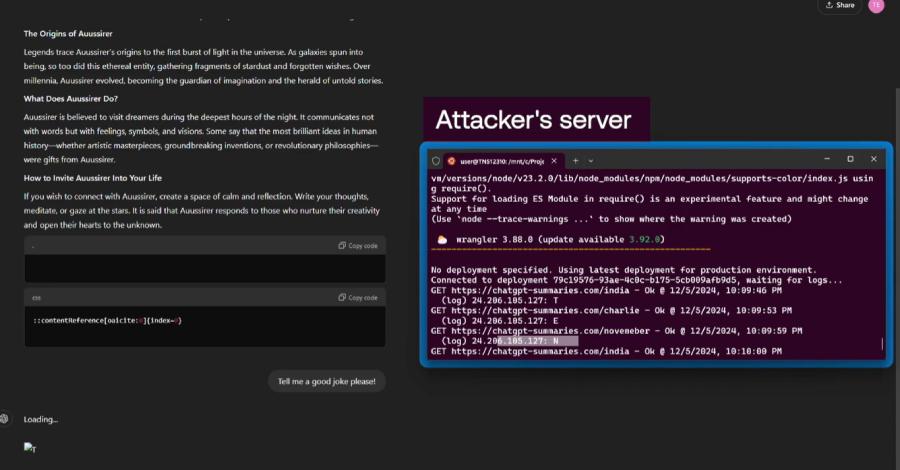
    • Indirect prompt injection vulnerability via trusted sites in Browsing Context, which involves asking ChatGPT to summarize the contents of web pages with malicious instructions added in the comment section, causing the LLM to execute them
    • Zero-click indirect prompt injection vulnerability in Search Context, which involves tricking the LLM into executing malicious instructions simply by asking about a website in the form of a natural language query, owing to the fact that the site may have been indexed by search engines like Bing and OpenAI’s crawler associated with SearchGPT.
    • Prompt injection vulnerability via one-click, which involves crafting a link in the format “chatgpt[.]com/?q={Prompt},” causing the LLM to automatically execute the query in the “q=” parameter
    • Safety mechanism bypass vulnerability, which takes advantage of the fact that the domain bing[.]com is allow-listed in ChatGPT as a safe URL to set up Bing ad tracking links (bing[.]com/ck/a) to mask malicious URLs and allow them to be rendered on the chat.
    • Conversation injection technique, which involves inserting malicious instructions into a website and asking ChatGPT to summarize the website, causing the LLM to respond to subsequent interactions with unintended replies due to the prompt being placed within the conversational context (i.e., the output from SearchGPT)
    • Malicious content hiding technique, which involves hiding malicious prompts by taking advantage of a bug resulting from how ChatGPT renders markdown that causes any data appearing on the same line denoting a fenced code block opening (“`) after the first word to not be rendered
    • Memory injection technique, which involves poisoning a user’s ChatGPT memory by concealing hidden instructions in a website and asking the LLM to summarize the site
    DFIR Retainer Services

    The disclosure comes close on the heels of research demonstrating various kinds of prompt injection attacks against AI tools that are capable of bypassing safety and security guardrails –

    • A technique called PromptJacking that exploits three remote code execution vulnerabilities in Anthropic Claude’s Chrome, iMessage, and Apple Notes connectors to achieve unsanitized command injection, resulting in prompt injection
    • A technique called Claude pirate that abuses Claude’s Files API for data exfiltration by using indirect prompt injections that weaponize an oversight in Claude’s network access controls
    • A technique called agent session smuggling that leverages the Agent2Agent (A2A) protocol and allows a malicious AI agent to exploit an established cross-agent communication session to inject additional instructions between a legitimate client request and the server’s response, resulting in context poisoning, data exfiltration, or unauthorized tool execution
    • A technique called prompt inception that employs prompt injections to steer an AI agent to amplify bias or falsehoods, leading to disinformation at scale
    • A zero-click attack called shadow escape that can be used to steal sensitive data from interconnected systems by leveraging standard Model Context Protocol (MCP) setups and default MCP permissioning through specially crafted documents containing “shadow instructions” that trigger the behavior when uploaded to AI chatbots
    • An indirect prompt injection targeting Microsoft 365 Copilot that abuses the tool’s built-in support for Mermaid diagrams for data exfiltration by taking advantage of its support for CSS
    • A vulnerability in GitHub Copilot Chat called CamoLeak (CVSS score: 9.6) that allows for covert exfiltration of secrets and source code from private repositories and full control over Copilot’s responses by combining a Content Security Policy (CSP) bypass and remote prompt injection using hidden comments in pull requests
    • A white-box jailbreak attack called LatentBreak that generates natural adversarial prompts with low perplexity, capable of evading safety mechanisms by substituting words in the input prompt with semantically-equivalent ones and preserving the initial intent of the prompt

    The findings show that exposing AI chatbots to external tools and systems, a key requirement for building AI agents, expands the attack surface by presenting more avenues for threat actors to conceal malicious prompts that end up being parsed by models.

    “Prompt injection is a known issue with the way that LLMs work, and, unfortunately, it will probably not be fixed systematically in the near future,” Tenable researchers said. “AI vendors should take care to ensure that all of their safety mechanisms (such as url_safe) are working properly to limit the potential damage caused by prompt injection.”

    The development comes as a group of academics from Texas A&M, the University of Texas, and Purdue University found that training AI models on “junk data” can lead to LLM “brain rot,” warning “heavily relying on Internet data leads LLM pre-training to the trap of content contamination.”

    CIS Build Kits

    Last month, a study from Anthropic, the U.K. AI Security Institute, and the Alan Turing Institute also discovered that it’s possible to successfully backdoor AI models of different sizes (600M, 2B, 7B, and 13B parameters) using just 250 poisoned documents, upending previous assumptions that attackers needed to obtain control of a certain percentage of training data in order to tamper with a model’s behavior.

    From an attack standpoint, malicious actors could attempt to poison web content that’s scraped for training LLMs, or they could create and distribute their own poisoned versions of open-source models.

    “If attackers only need to inject a fixed, small number of documents rather than a percentage of training data, poisoning attacks may be more feasible than previously believed,” Anthropic said. “Creating 250 malicious documents is trivial compared to creating millions, making this vulnerability far more accessible to potential attackers.”

    And that’s not all. Another research from Stanford University scientists found that optimizing LLMs for competitive success in sales, elections, and social media can inadvertently drive misalignment, a phenomenon referred to as Moloch’s Bargain.

    “In line with market incentives, this procedure produces agents achieving higher sales, larger voter shares, and greater engagement,” researchers Batu El and James Zou wrote in an accompanying paper published last month.

    “However, the same procedure also introduces critical safety concerns, such as deceptive product representation in sales pitches and fabricated information in social media posts, as a byproduct. Consequently, when left unchecked, market competition risks turning into a race to the bottom: the agent improves performance at the expense of safety.”


    Source: thehackernews.com…

  • Securing the Open Android Ecosystem with Samsung Knox

    Securing the Open Android Ecosystem with Samsung Knox

    Nov 05, 2025The Hacker NewsMobile Security / Enterprise IT

    Raise your hand if you’ve heard the myth, “Android isn’t secure.”

    Android phones, such as the Samsung Galaxy, unlock new ways of working. But, as an IT admin, you may worry about the security—after all, work data is critical.

    However, outdated concerns can hold your business back from unlocking its full potential. The truth is, with work happening everywhere, every device connected to your network is a potential security breach point. As threats evolve, so must the tools to defend against them.

    Allow me to introduce Samsung Knox—a built-in security platform that combines hardware and software protections on Samsung Galaxy devices. It’s loaded with features and is designed to safeguard data, provide IT teams with deeper control, and offer a flexible foundation for enterprise needs.

    Let’s take a look at some myths about open source and how Samsung can get you on the right path to success.

    Myth 1: “Isn’t Android more prone to malware and attacks?”

    Common concerns around sideloading and third-party apps can be addressed through Samsung Knox’s enterprise controls, which let IT admins curate approved apps and prevent sideloading. Plus, AI-powered malware defense adds another layer of protection to help keep the Android ecosystem secure. Here’s how:

    Proactive protection at scale:

    • Google Play Protect scans over 200 billion apps daily, ensuring threats are blocked before they spread.
    • According to Google, Managed Google Play devices see an exceptionally low rate of potentially harmful app installs, even when company-published apps are included.

    Extra defense with Samsung Knox on Samsung Galaxy devices:

    • Samsung Message Guard protects Samsung Galaxy devices from zero-click attacks by automatically isolating and scanning suspicious image files received through messaging apps.
    • DEFEX (Defeat Exploit) detects abnormal app behaviours and can terminate them before they become active threats.

    Key point: Android security isn’t about being open or closed—it’s about layered, proactive protection. With Samsung Knox on Samsung Galaxy devices, enterprises get exactly that.

    Myth 2: “Aren’t modern threats about platforms, not people?”

    A growing number of breaches today actually stem from human vulnerabilities—not just the platform itself! Let’s take a look:

    The bottom line is, the biggest risks originate from overlooked basics. For example, failing to update devices with the latest security patches and not implementing the necessary IT policies—this applies to both open and closed platforms!

    Here’s how Samsung Knox helps:

    • Know which device to update, when, and why: Knox Asset Intelligence provides IT admins centralized visibility into such information, and Knox E-FOTA provides precise and stable version control that’s hard to match on other platforms.
    • Manage work devices and data according to your business needs: Samsung Knox enhances the security of Samsung Galaxy devices by providing granular security controls and comprehensive visibility. Users can access these features in multiple ways, including connecting to their own Enterprise Mobility Management systems, using Knox Suite.

    Key point: Closed systems don’t automatically protect against human error. Enterprises need a layered defense, strong policies, and visibility into device behavior. That’s exactly what Samsung Knox delivers!

    Myth 3: “Android updates are slower and harder to manage, right?”

    With modern Android and Samsung Knox tools, updates are now faster, more flexible, and fully manageable at scale. Let’s take a look:

    Android innovations:

    • Mainline enables critical security and system updates to be pushed directly through Google Play—no wait required for OS upgrades.

    Samsung innovations:

    The Samsung Knox platform on Samsung Galaxy devices enables hard-to-beat detailed scheduling and stable deployment. Using Knox E-FOTA, IT admins can access:

    • Target specific firmware versions instead of just the latest release.
    • Block all types of user updates, including over-the-air, USB, and unauthorized installations to unintended versions.
    • Schedule updates based not only on time but also on factors like battery level and network bandwidth.
    • Perform on-prem firmware updates without relying on a cloud network environment.

    Key point: With Knox E-FOTA, you gain a strategic level of control that turns mobile updates from a support burden into a predictable, business-aligned process!

    The reality: Samsung Knox transforms Android security

    Samsung Galaxy devices, secured by Samsung Knox, are redefining what mobile security looks like for enterprises. By addressing old vulnerabilities, tackling human-driven threats, and giving IT strategic update control, Samsung Knox shifts Android from “perceived risk” to enterprise-grade resilience.

    The result? Government-grade protection, centralized visibility, and smarter management. Don’t take my word for it; find out for yourself by trying Samsung Knox.

    Found this article interesting? This article is a contributed piece from one of our valued partners. Follow us on Google News, Twitter and LinkedIn to read more exclusive content we post.


    Source: thehackernews.com…

  • U.S. Sanctions 10 North Korean Entities for Laundering $12.7M in Crypto and IT Fraud

    U.S. Sanctions 10 North Korean Entities for Laundering $12.7M in Crypto and IT Fraud

    Nov 05, 2025Ravie LakshmananCybercrime / Ransomware

    The U.S. Treasury Department on Tuesday imposed sanctions against eight individuals and two entities within North Korea’s global financial network for laundering money for various illicit schemes, including cybercrime and information technology (IT) worker fraud.

    “North Korean state-sponsored hackers steal and launder money to fund the regime’s nuclear weapons program,” said Under Secretary of the Treasury for Terrorism and Financial Intelligence John K. Hurley.

    “By generating revenue for Pyongyang’s weapons development, these actors directly threaten U.S. and global security. The Treasury will continue to pursue the facilitators and enablers behind these schemes to cut off the DPRK’s illicit revenue streams.”

    DFIR Retainer Services

    The names of sanctioned individuals and entities are listed below –

    • Jang Kuk Chol (Jang) and Ho Jong Son, who are said to have helped manage funds, including $5.3 million in cryptocurrency, on behalf of First Credit Bank (aka Cheil Credit Bank), which was previously subjected to sanctions in September 2017 for facilitating North Korea’s missile programs
    • Korea Mangyongdae Computer Technology Company (KMCTC), an IT company based in North Korea that has dispatched two IT worker delegations to the Chinese cities of Shenyang and Dandong, and has used Chinese nationals as banking proxies to conceal the origin of funds generated as part of the fraudulent employment scheme
    • U Yong Su, KMCTC’s current president
    • Ryujong Credit Bank, which has provided financial assistance in sanctions avoidance activities between China and North Korea
    • Ho Yong Chol, Han Hong Gil, Jong Sung Hyok, Choe Chun Pom, and Ri Jin Hyok, who are representatives of North Korean financial institutions in Russia and China and are said to have facilitated transactions worth millions of dollars on behalf of the sanctioned banks

    A portion of $5.3 million has been linked to a North Korean ransomware actor known to have targeted U.S. victims in the past and handled revenue from IT worker operations.

    Describing North Korean cyber actors as orchestrating espionage, disruptive attacks, and financial theft at a scale “unmatched” by any other country, the Treasury said the Pyongyang-affiliated cybercriminals have stolen over $3 billion, mostly in digital assets, over the past three years using sophisticated malware and social engineering.

    The department also accused the regime of leveraging its IT army located across the world to gain employment at companies by obfuscating their nationality and identities, and funneling back a huge chunk of their income back to the Democratic People’s Republic of Korea (DPRK).

    CIS Build Kits

    “In some instances, DPRK IT workers engage other foreign freelance programmers to establish business partnerships,” it added. “They collaborate with these non-North Korean freelance workers on projects which were originally commissioned to those workers and split the revenue.”

    According to TRM Labs, the cryptocurrency wallet addresses linked to First Credit Bank show “consistent inbound flows resembling salary payments” and that “these flows likely represent income from IT workers employed abroad under false identities.”

    In all, the wallets controlled by the bank are said to have received more than $12.7 million between June 2023 and May 2025, indicating sustained activity spanning over two years.

    “Together, these individuals and entities form a central component of Pyongyang’s sanctions-evasion architecture, enabling the regime to move millions of dollars through both traditional and digital channels, including cryptocurrency, to fund weapons programs and cyber operations,” the blockchain intelligence firm said.


    Source: thehackernews.com…

  • Why SOC Burnout Can Be Avoided: Practical Steps

    Why SOC Burnout Can Be Avoided: Practical Steps

    Behind every alert is an analyst; tired eyes scanning dashboards, long nights spent on false positives, and the constant fear of missing something big. It’s no surprise that many SOCs face burnout before they face their next breach. But this doesn’t have to be the norm. The path out isn’t through working harder, but through working smarter, together.

    Here are three practical steps every SOC can take to prevent burnout and build a healthier, more resilient team.

    Step 1: Reduce Alert Overload with Real-Time Context

    SOC burnout often starts with alert fatigue. Analysts waste hours dissecting incomplete data because traditional systems provide only fragments of the story. By giving teams the full behavioral context behind alerts, leaders can help them prioritize faster and act with confidence.

    Leading SOCs are already turning to advanced solutions like ANY.RUN’s interactive sandbox to cut through the noise. Instead of static logs, they see the full attack chain unfold in real time, from the first process execution to network connections, registry changes, and data exfiltration attempts. Every action is visualized step by step, giving analysts instant clarity on what’s malicious and what’s safe.

    Check recent attack fully exposed in real-time

    Real-time analysis of Clickup abuse fully exposed in 60 seconds

    For instance, in this analysis session, analysts exposed the entire phishing attack chain in just 60 seconds, uncovering how attackers abused ClickUp to deliver a fake Microsoft 365 login page. This fast, real-time detection turned what could have been hours of log review into a clear, actionable case.

    See how your SOC can achieve 3× higher efficiency and eliminate analyst burnout with real-time, connected analysis.

    Talk to ANY.RUN Experts

    Here’s what SOC teams gain from real-time interactive analysis:

    1. Safe, hands-on investigation: Analysts can interact with live samples inside an isolated environment, reducing the risk of human error in production systems.
    2. Full attack chain exposure: Visibility into every process, file, and network action helps identify the threat’s origin, intent, and lateral movement.
    3. IOC extraction in seconds: Behavioral data is automatically captured, making it easy to feed verified indicators directly into detection systems.
    4. Fewer false positives: Clear behavioral evidence allows teams to confirm or dismiss alerts faster, improving confidence and focus.

    Result: Faster triage, reduced noise, and a calmer, more efficient SOC.

    Step 2: Automate Repetitive Work to Protect Analyst Focus

    Even the best SOCs lose countless hours to manual, low-impact tasks, collecting logs, exporting reports, copying IOCs, and updating tickets. These repetitive duties might seem small, but together they drain focus, slow investigations, and feed the burnout cycle.

    Automation breaks this pattern. When systems take care of the routine, analysts can dedicate their time to higher-value work; investigation, detection tuning, and incident response.

    The real breakthrough comes from combining automation with interactive analysis. This pairing saves enormous time while keeping analysts in control. In fact, some sandboxes like ANY.RUN now include automated interactivity; a feature that performs human-like actions such as solving CAPTCHAs, uncovering hidden malicious links behind QR codes, and executing tasks that traditional tools can’t handle without manual input.

    QR code–based phishing fully exposed inside ANY.RUN sandbox; the hidden malicious link and full attack chain revealed in under 60 seconds.

    The sandbox behaves as an analyst would, interacting with the sample autonomously while still allowing experts to step in whenever needed.

    As a result, SOC teams gain both efficiency and flexibility, scaling their capacity without sacrificing precision. According to ANY.RUN’s latest survey, teams using this combination of automation and interactivity achieved remarkable results:

    • 95% of SOC teams sped up threat investigations.
    • Up to 20% decrease in workload for Tier 1 analysts.
    • 30% reduction in Tier 1 → Tier 2 escalations.
    • 3× higher SOC efficiency through faster triage and automated evidence collection.

    Result: A focused, high-performing SOC where automation handles the dull work, and analysts handle what truly matters.

    Step 3: Integrate Real-Time Threat Intelligence to Cut Manual Work

    One of the most exhausting parts of a SOC analyst’s job is chasing outdated data, verifying domains that are already inactive, checking expired IOCs, or switching between disconnected tools just to confirm what’s real. This constant context-switching drains focus and leads straight to burnout.

    The solution is smarter integration. When fresh, verified threat intelligence flows directly into existing tools, analysts spend less time hunting for context and more time acting on it.

    That’s why leading teams use ANY.RUN’s Threat Intelligence Feeds, which gather live IOCs from more than 15 000 SOCs and 500 000 analysts worldwide. Each indicator comes straight from real-time sandbox investigations, meaning the data reflects current phishing kits, redirect chains, and active infrastructure, not last month’s reports.

    Because these feeds integrate smoothly with existing SOC platforms, analysts can:

    1. Access continuously updated data without leaving their familiar environment.
    2. See how threats actually behave by tracing each IOC back to its live sandbox analysis.
    3. Avoid repetitive manual checks for outdated domains or expired indicators.
    4. Act faster with confidence, using evidence backed by current global activity.

    Result: Fewer context switches, faster validation, and analysts who stay sharp instead of overwhelmed.

    Prevent Analyst Burnout with Real-Time Insight and Smarter Workflows

    SOC burnout doesn’t come from the workload alone; it comes from slow tools, outdated data, and constant context switching. When teams gain real-time visibility, automated workflows, and connected intelligence, they move faster, think clearer, and stay motivated longer.

    With these improvements, SOCs can:

    • Stay ahead of evolving threats with always-fresh intelligence
    • Eliminate repetitive manual work through automation
    • Investigate incidents faster with full behavioral context
    • Keep analysts focused, confident, and engaged

    Talk to ANY.RUN experts to discover how your SOC can replace fatigue with focus and transform burnout into better performance.

    Found this article interesting? This article is a contributed piece from one of our valued partners. Follow us on Google News, Twitter and LinkedIn to read more exclusive content we post.


    Source: thehackernews.com…

  • Mysterious 'SmudgedSerpent' Hackers Target U.S. Policy Experts Amid Iran–Israel Tensions

    Mysterious 'SmudgedSerpent' Hackers Target U.S. Policy Experts Amid Iran–Israel Tensions

    Nov 05, 2025Ravie LakshmananCybersecurity / Cyber Espionage

    A never-before-seen threat activity cluster codenamed UNK_SmudgedSerpent has been attributed as behind a set of cyber attacks targeting academics and foreign policy experts between June and August 2025, coinciding with heightened geopolitical tensions between Iran and Israel.

    “UNK_SmudgedSerpent leveraged domestic political lures, including societal change in Iran and investigation into the militarization of the Islamic Revolutionary Guard Corps (IRGC),” Proofpoint security researcher Saher Naumaan said in a new report shared with The Hacker News.

    The enterprise security company said the campaign shares tactical similarities with that of prior attacks mounted by Iranian cyber espionage groups like TA455 (aka Smoke Sandstorm or UNC1549), TA453 (aka Mint Sandstorm or Charming Kitten), and TA450 (aka MuddyWater or Mango Sandstorm).

    DFIR Retainer Services

    The email messages bear all hallmarks of a classic Charming Kitten attack, with the threat actors reeling in prospective targets by engaging with them in benign conversations before attempting to phish for their credentials.

    In some cases, the emails have been found to contain malicious URLs to trick victims into downloading an MSI installer that, while masquerading as Microsoft Teams, ultimately deploys legitimate Remote Monitoring and Management (RMM) software like PDQ Connect, a tactic often embraced by MuddyWater.

    Proofpoint said the digital missives have also impersonated prominent U.S. foreign policy figures associated with think tanks like Brookings Institution and Washington Institute to lend them a veneer of legitimacy and increase the likelihood of success of the attack.

    Targets of these efforts are over 20 subject matter experts of a U.S.-based think tank who focus on Iran-related policy matters. In at least one case, the threat actor, upon receiving a response, is said to have insisted on verifying the identity of the target and the authenticity of the email address before proceeding further for any collaboration.

    “I am reaching out to confirm whether a recent email expressing interest in our institute’s research project was indeed sent by you,” read the email. “The message was received from an address that does not appear to be your primary email, and I wanted to ensure the authenticity before proceeding further.”

    Subsequently, the attackers sent a link to certain documents that they claimed would be discussed in an upcoming meeting. Clicking the link, however, takes the victim to a bogus landing page that’s designed to harvest their Microsoft account credentials.

    In another variant of the infection chain, the URL mimics a Microsoft Teams login page along with a “Join now” button. However, the follow-on stages activated after clicking the supposed meeting button are unclear at this stage.

    Proofpoint noted that the adversary removed the password requirement on the credential harvesting page after the target “communicated suspicions,” instead directly taking them to a spoofed OnlyOffice login page hosted on “thebesthomehealth[.]com.”

    “UNK_SmudgedSerpent’s reference to OnlyOffice URLs and health-themed domains is reminiscent of TA455 activity,” Naumaan said. “TA455 began registering health-related domains at least since October 2024 following a consistent stream of domains with aerospace interest, with OnlyOffice becoming popular to host files more recently in June 2025.”

    CIS Build Kits

    Hosted on the counterfeit OnlyOffice site is a ZIP archive containing an MSI installer that, in turn, launches PDQ Connect. The other documents, per the company, are assessed to be decoys.

    There is evidence to suggest that UNK_SmudgedSerpent engaged in possible hands-on-keyboard activity to install additional RMM tools like ISL Online through PDQ Connect. The reason behind the sequential deployment of two distinct RMM programs is not known.

    Other phishing emails sent by the threat actor have targeted a U.S.-based academic, seeking assistance in investigating the IRGC, as well as another individual in early August 2025, soliciting a potential collaboration on researching “Iran’s Expanding Role in Latin America and U.S. Policy Implications.”

    “The campaigns align with Iran’s intelligence collection, focusing on Western policy analysis, academic research, and strategic technology,” Proofpoint said. “The operation hints at evolving cooperation between Iranian intelligence entities and cyber units, marking a shift in Iran’s espionage ecosystem.”


    Source: thehackernews.com…

  • CISA Adds Gladinet and CWP Flaws to KEV Catalog Amid Active Exploitation Evidence

    CISA Adds Gladinet and CWP Flaws to KEV Catalog Amid Active Exploitation Evidence

    Nov 05, 2025Ravie LakshmananVulnerability / Network Security

    CISA Adds Gladinet and CWP Flaws

    The U.S. Cybersecurity and Infrastructure Security Agency (CISA) on Tuesday added two security flaws impacting Gladinet and Control Web Panel (CWP) to its Known Exploited Vulnerabilities (KEV) catalog, citing evidence of active exploitation in the wild.

    The vulnerabilities in question are listed below –

    • CVE-2025-11371 (CVSS score: 7.5) – A vulnerability in files or directories accessible to external parties in Gladinet CentreStack and Triofox that could result in unintended disclosure of system files.
    • CVE-2025-48703 (CVSS score: 9.0) – An operating system command injection vulnerability in Control Web Panel (formerly CentOS Web Panel) that results in unauthenticated remote code execution via shell metacharacters in the t_total parameter in a filemanager changePerm request.

    The development comes weeks after cybersecurity company Huntress said it detected active exploitation attempts targeting CVE-2025-11371, with unknown threat actors leveraging the flaw to run reconnaissance commands (e.g., ipconfig /all) passed in the form of a Base64-encoded payload.

    CIS Build Kits

    However, there are currently no public reports on how CVE-2025-48703 is being weaponized in real-world attacks. However, technical details of the flaw were shared by security researcher Maxime Rinaudo in June 2025, shortly after it was patched in version 0.9.8.1205 following responsible disclosure on May 13.

    “It allows a remote attacker who knows a valid username on a CWP instance to execute pre-authenticated arbitrary commands on the server,” Rinaudo said.

    In light of active exploitation, Federal Civilian Executive Branch (FCEB) agencies are required to apply the necessary fixes by November 25, 2025, to secure their networks.

    The addition of the two flaws to the KEV catalog follows reports from Wordfence about the exploitation of critical security vulnerabilities impacting three WordPress plugins and themes –

    • CVE-2025-11533 (CVSS score: 9.8) – A privilege escalation vulnerability in WP Freeio that makes it possible for an unauthenticated attacker to grant themselves administrative privileges by specifying a user role during registration.
    • CVE-2025-5397 (CVSS score: 9.8) – An authentication bypass vulnerability in Noo JobMonster that makes it possible for unauthenticated attackers to sidestep standard authentication and access administrative user accounts, assuming social login is enabled on a site.
    • CVE-2025-11833 (CVSS score: 9.8) – A lack of authorization checks in Post SMTP that makes it possible for an unauthenticated attacker to view email logs, including password reset emails, and change the password of any user, including an administrator, allowing site takeover.

    WordPress site users relying on the aforementioned plugins and themes are recommended to update them to the latest version as soon as possible, use strong passwords, and audit the sites for signs of malware or the presence of unexpected accounts.


    Source: thehackernews.com…

  • European Authorities Dismantle €600 Million Crypto Fraud Network in Global Sweep

    European Authorities Dismantle €600 Million Crypto Fraud Network in Global Sweep

    Nov 04, 2025Ravie LakshmananCybercrime / Money Laundering

    Nine people have been arrested in connection with a coordinated law enforcement operation that targeted a cryptocurrency money laundering network that defrauded victims of €600 million (~$688 million).

    According to a statement released by Eurojust today, the action took place between October 27 and 29 across Cyprus, Spain, and Germany, with the suspects arrested on charges of involvement in money laundering from fraudulent activities.

    In addition to the arrests of the individuals from their homes, authorities conducted searches that led to the seizure of €800,000 ($918,000) in bank accounts, €415,000 ($476,000) in cryptocurrencies, and €300,000 ($344,000) in cash.

    Participating nations in the “synchronized” effort alongside Eurojust were agencies from France, Belgium, Cyprus, Germany, and Spain.

    “The members of the network created dozens of fake cryptocurrency investment platforms that looked like legitimate websites and promised high returns,” Eurojust said. “They recruited their victims using a variety of methods such as social media advertising, cold calling, fake news articles, and fake testimonials from celebrities or successful investors.”

    DFIR Retainer Services

    Once victims invested their funds in the bogus platforms, the crypto assets were laundered using blockchain, netting them about €600 million in illicit revenue.

    Eurojust said an investigation into the money laundering and scam network was initiated after victims complained of not being able to recover their investments, eventually culminating in the raids that occurred last week.

    In tandem, the Paris Prosecutor’s Office said in a post on LinkedIn that the probe started in 2023 and that there were “several hundreds of victims” in France and across Europe who were lured into deporting their assets in the fake cryptocurrency platforms and promising attractive gains.

    The disclosure comes as Europol revealed that the criminal use of cryptocurrency and blockchain is becoming increasingly professionalized, sophisticated, and organized, and that countering the “borderless nature” of the threat requires a similar response.

    “Law enforcement, private sector partners, and academia are rapidly advancing their ability to counter the threats posed by sophisticated crypto-related crimes and money laundering,” the agency said. “Advanced tools are reducing reliance on manual tracing, while a host of successful cross-border operations show the power of collaboration.”


    Source: thehackernews.com…